
What if the path to greater field alignment begins with stronger relationships?
By Fay Horwitt, ESHIP Alliance Field-Builder-in-Residence
Ecosystem builders have long taught communities that trust and relationships come before alignment. As our field matures and becomes more specialized, perhaps it's time for us to apply those same lessons to ourselves.
One of the lessons experienced ecosystem builders share most often is that healthy ecosystems are built on relationships.
When we enter or engage with a community, we don't begin by asking entrepreneurs, support organizations, funders, investors, educators, policymakers, and community leaders to agree on everything. We don't start by demanding alignment. Instead, we encourage them to get to know one another, listen to one another, build trust, and develop a deeper understanding of each other's perspectives, incentives, constraints, and contributions.
Why?
Because experienced ecosystem builders understand something important: alignment is rarely the starting point. More often, it is the outcome of strong relationships. Lately, I've found myself wondering whether our field has forgotten that lesson.
A Maturing Field
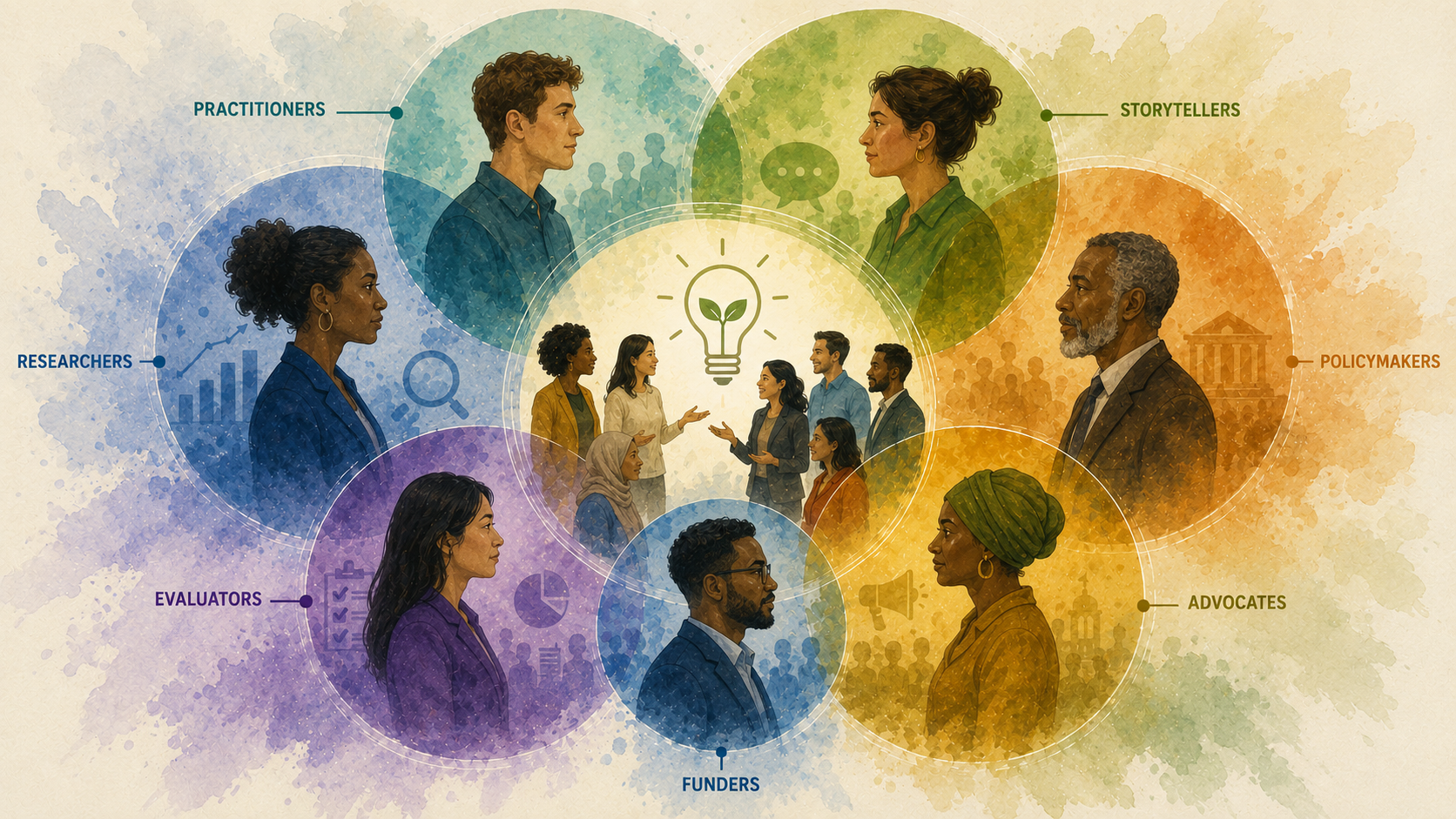
Over the past decade, entrepreneurial ecosystem development has evolved into a much more mature field of practice. Researchers have expanded our understanding of how ecosystems function. Practitioners have developed increasingly sophisticated approaches to ecosystem building. Evaluators have helped us better understand impact. Storytellers have elevated examples and lessons from communities around the world. Funders have invested significant resources into advancing the work. Advocates have challenged us to think more deeply about equity, access, and inclusion. Policymakers have increasingly recognized entrepreneurship as an important component of community and economic development.
These developments are signs of progress. But specialization has consequences.
The deeper we go into our individual roles, the easier it becomes to lose sight of the perspectives of others. Funders seek accountability while builders seek flexibility. Researchers shout out their frustration that practitioners don't use the evidence. Practitioners sometimes wonder why researchers aren't studying the questions they face every day. Evaluators seek rigor while storytellers seek resonance. Advocates push for systems change while policymakers navigate implementation realities.
None of these perspectives are wrong. In fact, each contributes something important. Yet despite our shared aspirations, we often find ourselves talking past one another.
What If We're Solving the Wrong Problem?
As I've reflected on this, I've started to wonder if we've been framing the challenge incorrectly. What if field alignment isn't primarily an alignment problem? What if it's a relationship problem?
For years, we've invested heavily in creating opportunities for field-level coordination. We've built networks, hosted conferences, published reports, launched initiatives, developed frameworks, and created countless opportunities for collaboration. All of that work matters. But perhaps we've focused more attention on coordinating stakeholders than on helping them truly understand one another.
Perhaps we've assumed that proximity creates understanding.That if we put people in the same room often enough, alignment will naturally emerge.
Yet that isn't what we teach communities.
In communities, we know that trust requires intention. Understanding requires curiosity. Relationships require investment. Meaningful collaboration rarely emerges without those foundations.
Why would our field be any different?
The Relationships Between Us
The more I think about it, the more I find myself wondering whether there is a chain of relationships within our field that deserves greater attention. Relationships between researchers and practitioners. Practitioners and evaluators. Evaluators and storytellers. Storytellers and advocates. Advocates and policymakers. Policymakers and funders. Funders and researchers.
Not because everyone needs to agree.
But because every one of those relationships represents a bridge between different forms of expertise, different incentives, and different ways of understanding the world.
When those bridges are strong, knowledge moves more effectively. Learning travels further. Resources flow more strategically. Stories carry greater meaning. Evidence becomes more useful. Collaboration becomes easier. When those bridges are weak, valuable insights often remain trapped within individual stakeholder groups, limiting our collective ability to learn, adapt, and advance the field.
I don't yet have a fully formed framework or solution. In fact, this feels more like an emerging observation than a conclusion. But I do think there is something worth exploring here.
A Recalibration
Perhaps the next chapter of entrepreneurial ecosystem development is not simply producing better research, stronger evaluations, more compelling stories, more effective policy, or greater investment.
Perhaps it is strengthening the relationships between the people responsible for those things.
Helping researchers better understand practitioners.
Helping evaluators better understand storytellers.
Helping funders better understand builders.
Helping policymakers better understand systems change advocates.
And helping all of us better understand the perspectives, pressures, incentives, and realities that shape one another's work.
Not because understanding guarantees alignment. But because understanding creates the conditions for trust. Trust creates the conditions for collaboration. And collaboration creates the conditions for alignment.
Perhaps this is simply a natural challenge for a growing and maturing field. As we become more specialized, we become more knowledgeable. But we can also become more disconnected. Maybe what is needed is not another initiative, organization, report, or framework. Maybe what is needed is a recalibration. A deliberate effort to strengthen the relationships that connect the people working to strengthen entrepreneurial ecosystems.
Because if there is one lesson ecosystem builders have spent years teaching communities, it is this: sustainable systems change emerges from relationships.
Perhaps it's time for us to take our own advice.
And maybe the next ecosystem we need to strengthen is our own - together.